
XERF structural skin tightening
Written and medically reviewed by Dr Vahe Karimyan MD, MS, PhD, Specialist Surgeon and Medical Director, Dr Vahe Clinic, Chelsea, London. Last reviewed 31 July 2026.
Almost every week, somebody sits down in my consulting room, pulls at the skin along their jaw with two fingers, lifts it a centimetre, and says: this. This is what I want. It is a fair way to describe the problem. It is also, quite often, the beginning of a difficult conversation, because no device on the market reproduces what those two fingers are doing.
What radiofrequency can do is something narrower and, in the right patient, genuinely useful. I want to explain what that is, in plain terms, and be equally clear about where it runs out of road.
On this page
What XERF™ is
What is actually happening in your skin
Who it helps, and who it will not help
Risks and side effects
How it compares with the other machines
What the appointment is like
Questions patients actually ask
References
What XERF™ skin tightening is
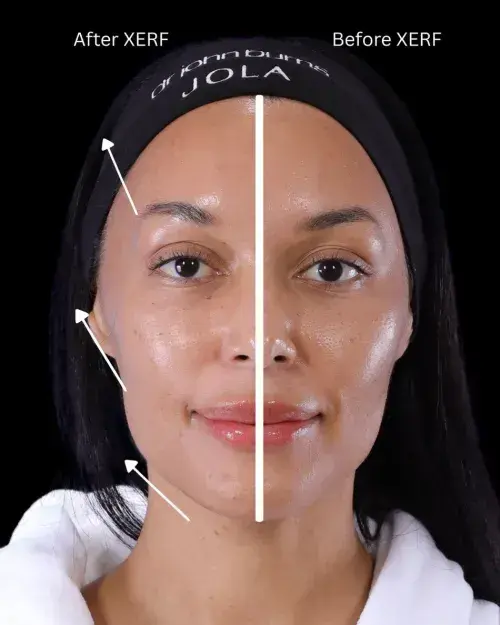
XERF™ is a radiofrequency treatment. Energy passes through the skin, meets resistance in the dermis, and that resistance turns into heat. Nothing is cut, nothing is injected, and nothing is pulled. The heat does two things: it makes existing collagen fibres shorten, and it irritates the cells that make new collagen into doing some work.
The first effect is the one patients notice on the day. You look in the mirror at the end of the session and the skin feels tauter. I always warn people that this is largely the tissue being warm. It fades. The part that matters takes months, and it happens quietly.
One practical advantage of XERF skin tightening radiofrequency over most light-based devices is that the energy is not absorbed by pigment. That makes it a reasonable option across a much wider range of skin tones than, say, an ablative laser, which is not a small consideration in a city like London.

The unglamorous truth is that XERF™ improves the quality and tension of skin. It does not reposition the deeper structures of the face, and it does not replace volume you have lost. When those are the real problem, and often they are, I will tell you so, and we will talk about whether Sculptra, Profhilo, polynucleotides, CO2 resurfacing, Endolyft or a surgical option is the better use of your money.
What is actually happening in your skin
Radiofrequency does not tighten skin so much as it starts a small, controlled healing process. It is worth knowing the sequence, because it explains why nothing much appears to be happening for the first month and why patients who judge the result at three weeks judge it too early.
On the day, collagen fibres partially unwind and contract as the dermis reaches its target temperature. Over the first week, blood flow to the area increases and the signalling that recruits fibroblasts switches on. Between roughly two and six weeks those fibroblasts start laying down new type III collagen along with elastin, and this is usually the first point at which the change is real rather than thermal.

From about two to four months, that early collagen is gradually swapped out for stronger, better organised type I collagen. The dermis thickens slightly and the skin regains some of its recoil. Most people see their clearest result somewhere between three and six months, which is why I photograph everyone at baseline and review them at three months rather than sending them a questionnaire a fortnight later.
After that, the new collagen is your own tissue and it ages at the same rate as the rest of you. A session once a year keeps pace with that. It does not stop it.
Who it helps, and who it will not help
The patients who do best are the ones whose skin has lost its snap but has not yet lost its position. Early jowling that has blurred a previously clean jawline. Crepiness on the neck. A softening under the chin. Peri-orbital skin that has gone slightly papery. Patients in their thirties and forties who want to slow things down rather than correct them. Patients who are not ready for surgery, or who do not want it at all.
We treat the face, jawline, neck, submental area, cheeks, around the eyes and the forehead, and selected body regions including the abdomen, arms and knees, where the sessions are longer and the settings are different because the dermis is thicker.
The patients who do less well are the ones with genuinely heavy tissue. If skin and fat have descended, heating the dermis will improve its quality without changing where it sits, and the result will disappoint you. I would rather have that conversation before you spend anything than at your review.

There are also people we simply do not treat with radiofrequency. Pregnancy and breastfeeding. Active infection or inflammatory skin disease in the area. Pacemakers, implanted defibrillators and other active electrical implants, where the manufacturer's guidance is unambiguous. Some autoimmune and connective tissue conditions. Recent isotretinoin, or a recent procedure in the same area that makes treating now unwise. That list is a starting point rather than a final answer, because some of these can be worked around and some cannot, which is what the medical screening is for.
Risks and side effects
Redness and warmth for a few hours are expected rather than complications. Mild swelling is common, particularly around the eyes, jawline and under the chin, and it generally settles within one to three days. Some people find the area tender to touch for a few days, usually over bone. Temporary numbness or a slightly odd sensation happens occasionally and resolves on its own.
Less common, and worth taking seriously: heat close to a superficial nerve can cause temporary weakness or altered sensation, which the literature suggests resolves over weeks to a few months. Blistering or a superficial burn is rare, and avoiding it is the entire reason the handpiece is kept moving, the energy titrated and the surface cooled. Pigment change can follow any heat-based treatment and is more likely in richly pigmented skin or if you go into the sun afterwards, so daily SPF 50 is not optional. On the body, small firm areas can occasionally be felt in treated fat, and these usually settle.
The last risk is the one clinics rarely list. Some people respond less than we hoped. If that is you, we will either plan another session or accept that radiofrequency is not going to give you what you want, and say so.
How it compares with the other machines
Patients usually arrive having read about three or four devices and wanting to know which is best. None of them is best. They do different things, and the honest answer depends on your tissue and your tolerance for discomfort and downtime.
Treatment | How it works | Downtime | Comfort | Typical sessions | Best suited to |
XERF™ | Radiofrequency through intact skin, heating a broad volume of dermis | Pinkness for a few hours | Warm, usually tolerated without anaesthetic | 1 to 3, several weeks apart | Mild to moderate laxity of face, jawline or neck, across a wide range of skin tones |
Ultherapy | Micro-focused ultrasound with imaging of the treatment plane | Minimal, sometimes swelling or tenderness | Can be sharp at depth, pain relief often used | Usually 1 | Deeper-plane lifting with imaging guidance |
Sofwave | Parallel ultrasound beams targeting the mid dermis | Minimal | Warm pulses with surface cooling | Usually 1, occasionally 2 | Fine lines and early laxity, short appointments |
Morpheus8 | Microneedles delivering radiofrequency below the surface | Around 3 to 5 days of marks and redness | Topical anaesthetic normally needed | Typically 3, monthly | Texture and resurfacing alongside tightening |
Thermage | Monopolar radiofrequency, single-pass protocol | Minimal | Brief heat spikes with cryogen cooling | Usually 1 per year | An established single-session radiofrequency option |
The other question I get constantly is how radiofrequency differs from HIFU. Focused ultrasound puts small thermal points at fixed depths. Radiofrequency heats a wider volume more evenly. Ultrasound reaches deeper. Radiofrequency is usually more comfortable. That is genuinely the whole of it.
What the appointment is like
Your first visit is mostly talking and assessing. I want to know what bothers you in photographs, what you have had done before, what medication you take, whether you have any implanted devices, and how much intervention you actually want, which is a question people are rarely asked and often have a firm view on.
We then run an OBSERV 520 skin analysis, which photographs the skin under several light modes and shows texture, pigment and vascular detail that ordinary lighting hides. Standardised clinical photographs are taken at the same time. Those two things together are what make your three-month review an honest comparison rather than a matter of opinion.
Treatment itself takes around forty-five minutes for the eyes, an hour or so for the lower face or neck, and up to ninety minutes for a full face and neck. Anaesthetic is not usually needed. The skin is cleansed, a conductive gel is applied, and the handpiece works in passes across each zone while the surface is cooled. Most people describe a rolling warmth, occasionally a brief hot spot that disappears the moment the handpiece moves on. I ask you to score the sensation as we go and adjust accordingly, which is a better safety system than any preset protocol.
Afterwards you can go back to work. Skip the sauna, the steam room and the gym for a day, wear SPF 50, keep the skin simple for the first twenty-four hours, and put makeup on the following morning if you want to, or a few hours later once any pinkness has gone.
Questions patients actually ask
Will it hurt?
Not usually. It is a deep, spreading heat rather than a sharp sensation, and the surface cooling does most of the work in keeping it tolerable. If a particular zone is uncomfortable we drop the energy for that zone.
How many sessions will I need?
Some patients get what they wanted from one. More established laxity usually does better with two or three, spaced several weeks apart. I would rather decide that after seeing your skin analysis than promise you a number in advance.
How long will it last?
The collagen you make is your own, so improvements generally hold for somewhere around twelve to eighteen months. Most patients come back once a year. Sun protection and not smoking will do more for the longevity of your result than anything I can sell you.
Can it replace a facelift?
No, and anyone who tells you otherwise is selling something. Surgery removes and repositions tissue. Radiofrequency improves the quality of skin that is still broadly where it should be. Because I operate as well, I have no particular incentive to steer you towards a machine when you would be better served by an operation, or the reverse.
Will it get rid of a double chin?
It will tighten the skin under the chin, which often sharpens the profile a little. It does not remove fat. If fat is the main issue, we should be discussing something else.
I have had filler and Botox. Is that a problem?
Not usually, with sensible spacing. I generally let toxin settle for a couple of weeks and hyaluronic acid filler for two to four weeks before applying heat to the same area. Tell me about everything you have had in the last six months, including anything done elsewhere.
Does it work on darker skin?
Radiofrequency does not target pigment, so it is a reasonable option across a wide range of skin tones. Suitability still depends on your history and your medication, not only on your skin type.
Do men have this?
Regularly, and mostly for the jawline and neck. Settings are adjusted for thicker, beard-bearing skin. The fact that nobody can tell you have had anything done is usually the main appeal.
Can it be combined with other treatments?
Yes, when there is a clinical reason. Polynucleotides for elasticity around the eyes and neck, Sculptra where structural support has gone as well as firmness, Profhilo Structura for the mid-face, CO2 laser for texture and pigment, Endolyft for more established jowling. Sequencing matters, so these are spaced rather than stacked, and I only suggest them when they add something.
Booking a consultation
Every XERF™ consultation and treatment at the clinic is planned and carried out under my direct supervision. The consultation includes a full medical assessment, OBSERV 560 skin analysis and a written plan, and there is no obligation to go ahead with anything. Call +44 20 3370 3503, email info@drvaheclinic.com or book through our online booking. We are at 25 Ives Street, Chelsea, London SW3 2ND, Monday to Saturday, 10:00 to 18:30, a short walk from South Kensington and Sloane Square.
About the author
Dr Vahe Karimyan MD, MS, PhD is a Specialist Surgeon and Medical Director of Dr Vahe Clinic, a CQC-registered private medical, surgical, aesthetic and regenerative medicine practice in Chelsea. He is GMC registered, holds a Master of Surgery and two doctorates, and has more than twenty years of experience in aesthetic, surgical and regenerative medicine alongside NHS practice at King's College Hospital.
Results vary between individuals and no outcome can be guaranteed. This article is general information and does not replace an in-person medical consultation.
References
Sadick N, Rothaus KO. Aesthetic applications of radiofrequency devices. Clinics in Plastic Surgery. 2016;43(3):557 to 565. doi:10.1016/j.cps.2016.03.014
Beasley KL, Weiss RA. Radiofrequency in cosmetic dermatology. Dermatologic Clinics. 2014;32(1):79 to 90. doi:10.1016/j.det.2013.09.010
El-Domyati M, El-Ammawi TS, Medhat W, et al. Radiofrequency facial rejuvenation: evidence-based effect. Journal of the American Academy of Dermatology. 2011;64(3):524 to 535. doi:10.1016/j.jaad.2010.06.045
Araújo AR, Soares VPC, Silva FS, Moreira TS. Radiofrequency for the treatment of skin laxity: myth or truth. Anais Brasileiros de Dermatologia. 2015;90(5):707 to 721. doi:10.1590/abd1806-4841.20153605
Medicines and Healthcare products Regulatory Agency. Medical devices: how to comply with the legal requirements in Great Britain. GOV.UK guidance.


Comments